Probate is a word people hear all the time, but few people really understand what it means. It comes up in wills, in conversations about aging parents, and in courtroom dramas on TV, almost always without a clear explanation attached. Probate in Alabama is simpler than it sounds once someone walks through how it works.
The confusion is not really about the idea of probate itself. It is about not knowing what happens next, who ends up in charge, and how much control you have if you never put a plan in place.
What Is Probate?
Probate is a court process. The court confirms that a will is valid, if one exists, and then oversees how a person’s property passes to their heirs or beneficiaries. This happens in the probate court of the county where the person lived.
Every estate falls into one of two categories. An estate with a valid will is called testate. An estate without one is called intestate. Both still go through the probate court, but the rules that control what happens next are different. That difference is worth understanding before assuming a will is not necessary.
How Does the Probate Process Work?
The steps are largely the same, whether the estate is simple or more complicated.
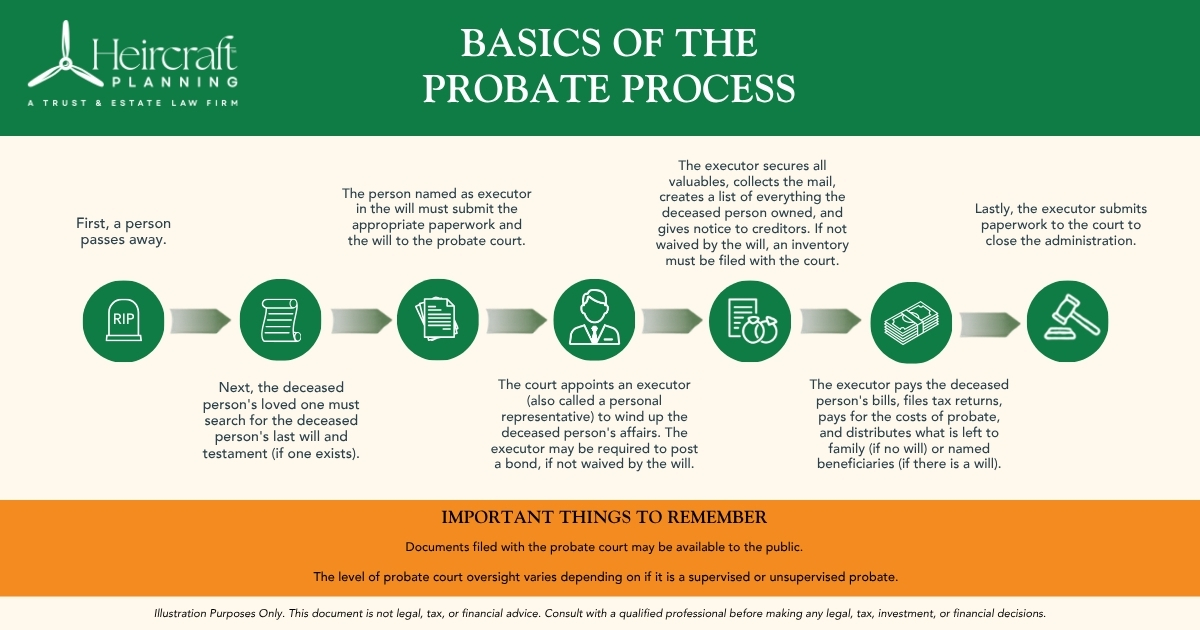
First, someone files a petition with the probate court to open the estate. This is usually the person named in the will, or a close family member if there is no will.
The court then issues a document called Letters Testamentary, or Letters of Administration if there is no will. This document is what actually gives the personal representative legal authority to act. Being named in a will is not enough on its own, since the court has to grant that authority first.
How Long Does Alabama Probate Take?
Once appointed, the personal representative notifies heirs and known creditors and publishes a public notice to creditors. State law gives creditors six months from that point to file a claim against the estate, and this window is a legal minimum, not a suggestion. That is why most straightforward estates take six to twelve months to close, while more complex or contested estates can take considerably longer.
During that time, the personal representative gathers and lists the estate’s assets, pays valid debts and taxes, and keeps records for the court. Once the waiting period ends and debts are resolved, what remains is distributed to the beneficiaries or heirs, and the estate is formally closed.
State law also allows a simpler process for smaller estates that fall under a specific dollar threshold. That threshold was recently increased and adjusts periodically, so the current figure should always be confirmed rather than assumed.
Does Probate Work Differently With a Will Than Without One?
The basic court process is the same either way. What changes is who controls the outcome.
With a valid will, the person who died gets to decide who inherits and who is named to manage the estate. The court still has to approve that person and issue Letters Testamentary, but the plan itself comes from the will.
Without a will, Alabama’s intestate succession law makes those decisions instead. A surviving spouse generally receives a set share of the estate, with the remainder divided among children, parents, or other relatives, depending on who survives. The exact shares depend on the specific family situation and are set by statute, so they should be confirmed against current law rather than assumed.
This is where the phrase the state decides for you actually applies. It does not mean the government keeps the property. Alabama law only allows that in the rare case where no relatives can be found at all. What it usually means is that someone other than the person the family expected ends up with the legal right to inherit or to serve as administrator. That might be a distant relative instead of a longtime partner or close friend, simply because that is the order the law follows.
Can Someone Contest a Will During Alabama Probate?
Yes. A will can be challenged after it is filed with the probate court, and this is one of the more stressful ways an estate can be delayed.
A contest usually argues one of a few things. Maybe the person did not have the mental capacity to make a will. Maybe someone pressured or manipulated them into it. Maybe the will was a product of fraud. Or maybe it was not signed and witnessed the way Alabama law requires.
Alabama law puts a limited window on how long someone has to bring a contest after a will is admitted to probate. That window is not indefinite, but the exact deadline should be confirmed against the current statute rather than assumed.
A contested will can add months, or longer, to the timeline described above, along with legal costs that come out of the estate. This is part of why clear, properly executed documents matter, not just having a will in the first place.
Can You Avoid Probate?
To some degree, yes, though it depends on how an estate is structured well before death.
A revocable living trust is the most common tool for this. Assets are transferred into the trust during a person’s lifetime, and a trustee manages them under the trust’s terms, often the same person while they are still alive. Because the trust already legally owns those assets, they do not need to go through the probate court when the person dies. Whoever is named to take over simply carries out the trust’s instructions.
A trust only works this way if it is actually funded, meaning the assets have been legally retitled in the trust’s name. A trust that exists on paper but was never funded does not avoid probate for whatever was left out of it.
What Other Tools Help Assets Skip Probate?
Other tools can also move specific assets outside of probate. Retirement accounts and life insurance pass directly to a named beneficiary. Accounts with a payable-on-death or transfer-on-death designation work the same way, and property owned jointly with rights of survivorship passes to the surviving owner automatically.
None of these tools fully replace the need for a will, since something usually still needs to cover whatever is left out. The right combination depends on the specific estate, which is a conversation worth having with an attorney rather than assuming one tool fits every situation.
Where Does Confusion Usually Happen?
A few misunderstandings come up again and again, and they are worth clearing up directly.
Having a will does not mean an estate skips probate. A will still has to go through the process. What it does is control how that process plays out and who is in charge.
People are also often surprised by the timeline. The six-month creditor period is set by law, not by how quickly the personal representative works, so even a simple, uncontested estate cannot close before that window ends.
Who Is Actually in Charge?
This is the part that gets overlooked, and it matters more than most people realize.
The personal representative is a fiduciary. That is not just a title. It means they have a legal duty to act in the best interest of the estate and its beneficiaries, a duty that includes defending the will if it is ever contested.
Being named in a will does not create that authority by itself. The authority comes from the court, through the Letters Testamentary or Letters of Administration. Until that happens, no one can act for the estate, not even the person clearly named in the will.
When there is no will, Alabama law decides who goes first in line to serve as administrator, based on family relationships rather than personal preference. The person a family expects to step in is not always the person the law recognizes first.
Why Does Understanding This Matter for Your Own Planning?
Probate is not something to fear. It exists to make sure an estate is settled the right way, and it steps in with its own default rules whenever a more specific plan is not already in place.
Understanding how intestate succession works, how a will can be contested, and how tools like a trust can simplify the process all help you make better choices for your own plan.
Naming a personal representative clearly, keeping beneficiary designations current, and deciding whether a trust fits your situation all matter. Together, they affect how smoothly things go for the people you leave behind.
Clarity now is what makes the process easier for your family later.
If you would like to learn more, Heircraft Planning offers several free resources. You can download our free estate planning guide, watch an on-demand webinar, or browse our full blog library at heircraftplanning.com. Free in-person seminars are held throughout the year in Mobile. View upcoming dates and register at heircraftplanning.com/upcoming-events.
If you are ready to take the next step, you can schedule a consultation with our team at heircraftplanning.com. We are here to help you understand your options and put a plan in place that reflects what matters most to you.