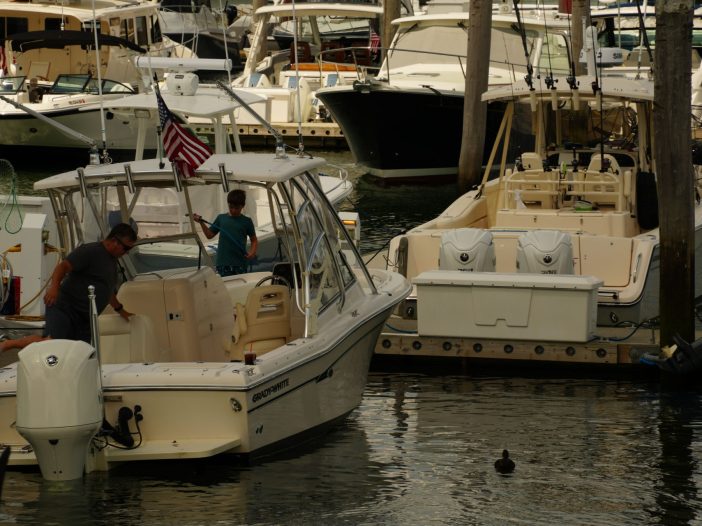
Grady-White’s recent ownership transfer made headlines because of the size of the number attached to it. For advisors, the more useful takeaway isn’t really about business succession. It’s about how charitable intent, control, and irrevocable structuring intersect, a question that shows up across nearly every kind of client, not only the ones who own a company.
This summer, Eddie Smith, the 83-year-old owner of Grady-White Boats, declined acquisition offers exceeding $400 million and instead transferred control of the company to a perpetual purpose trust. It is reportedly the largest transaction of its kind since Patagonia’s founder used a similar structure in 2022, and the first in the recreational marine industry.
To be direct about it: very few of your clients will ever be in a position to use this exact structure. A $400 million company and a founder with no heir is a specific set of circumstances, not a common one. We are not sharing this as broadly applicable advice.
We are sharing it because it is a genuinely interesting case study in how succession, charitable intent, and tax strategy intersect at the highest level, and the underlying logic shows up constantly at a smaller scale, in clients who are business owners and in clients who are not. Someone deciding how a retirement account, a piece of real estate, or a life insurance policy should support a cause they care about is working through a smaller version of the same questions Smith worked through. Who has control. What structure carries out the intent. What it costs to get there.
What Happened With Grady-White’s Ownership Transfer?
Smith purchased Grady-White in 1968 and built it into one of the most decorated builders in the marine industry. With no heir interested in or available to take over the company, and after watching peers in the industry lose control of their companies’ culture following a sale, Smith chose a structure designed to keep the business private, independent, and mission-aligned in perpetuity.
Under the new structure, Grady-White’s voting stock now belongs to a newly formed entity, the Grady-White Boats Perpetual Purpose Trust. The non-voting stock, which carries the right to profits, was transferred to a newly formed 501(c)(4) organization. Neither entity is controlled by Smith, and both are governed by independent boards. It is, at its core, a question of authority: who controls the asset going forward, and who benefits from what it produces, are no longer the same answer.
The company’s existing leadership team remains in place, and Smith has moved into a non-operational role as CEO emeritus, drawing a salary but retaining no equity and no claim to any future sale proceeds.
Reported terms indicate that 95 percent of future profits will flow to the nonprofit for charitable distribution, with causes including conservation, health care, and education.
How Does a Perpetual Purpose Trust Actually Work?
A perpetual purpose trust is not a traditional estate planning trust in the sense most clients are familiar with. It does not name individual beneficiaries. It exists to carry out a stated purpose, in this case, preserving Grady-White’s operating values and directing its profits to charity, indefinitely.
The split between voting and non-voting stock is what makes the structure work. Control sits with the purpose trust, which exists solely to enforce the founder’s stated mission. Economic benefit sits with the nonprofit, which exists to distribute profits according to that mission. Separating control from profit rights is what allows the asset to continue operating independently rather than being absorbed into a sale, while still directing its financial output toward a charitable purpose.
Independent governance of both entities is not optional. It is what prevents the structure from functioning as a disguised form of continued personal control, which would undermine both the charitable purpose and the tax treatment the structure depends on.
One detail worth noting for planning purposes: Smith reportedly declined to claim a personal tax benefit for the stock transfer, in addition to giving up any proceeds from a future sale. That is a meaningful data point, since the tax and economic tradeoffs of a purpose trust are not automatically favorable to the founder personally. They depend heavily on how the transaction is structured.
What Are the Tax and Estate Planning Considerations?
Purpose trusts sit at the far end of a spectrum of tools available to anyone who wants to combine control, succession, and charitable intent. Almost no client will sit at that end of the spectrum, but the mechanics are worth understanding, since the same tradeoffs show up, at a smaller scale, in the tools covered in the next section.
Neither Alabama nor Florida imposes a state estate tax, so for clients in both states, the exposure below is entirely a federal consideration.
Estate tax exposure. Removing a highly appreciated asset from an owner’s taxable estate through an irrevocable structure like this can meaningfully reduce future federal estate tax liability, since the asset is no longer counted among the owner’s holdings at death.
Gift tax exposure. Because the stock is not transferred directly to a public charity, and instead moves through a trust and a 501(c)(4) rather than a straightforward charitable gift, the transfer can still trigger gift tax. When Patagonia’s founder used this structure, his family reportedly faced an estimated $17.5 million gift tax liability, even though the transaction was philanthropically motivated.
Capital gains avoidance. Transferring ownership through a trust structure rather than a taxable sale can avoid substantial capital gains tax. In the Patagonia transaction, the estimated savings were reported at roughly $700 million, which is the primary reason these structures draw attention from tax and estate planning professionals even when the charitable motivation is genuine.
Irrevocability. These structures are generally permanent. Anyone considering this route is not just choosing a charitable strategy. They are permanently giving up personal control and any future economic upside in the asset, which makes this a poor fit for anyone who has not fully resolved their own liquidity needs and long-term intentions first.
What Charitable and Succession Tools Do Alabama and Florida Clients Actually Use?
Perpetual purpose trusts remain rare. The reported figure is 81 U.S. companies since 2018, up from seven. For nearly all of your clients, more conventional tools accomplish a similar goal, on a scale and for an asset type that actually fits their situation:
- Donor-advised funds let a client set aside cash, securities, or other appreciated assets for charitable giving, take an immediate tax benefit, and recommend grants over time. This works for any client with charitable intent, not only business owners.
- Charitable remainder trusts and charitable lead trusts let a client direct real estate, investments, or business interests toward a charitable purpose while retaining or providing income during their lifetime.
- Beneficiary designations let a client name a charity directly on a life insurance policy or retirement account, passing outside probate in both Alabama and Florida.
- Buy-sell agreements paired with life insurance address the succession problem specific to business-owning clients, where the business needs to transition to a partner, family member, or key employee without becoming a forced sale at death.
- ESOPs and other employee ownership structures can accomplish some of what a purpose trust does for employee continuity and culture preservation, without requiring the same degree of charitable commitment. This one is business-specific as well.
The Grady-White transaction is useful less as a template and more as a prompt. It puts a concrete, well-reported example in front of clients who may not have previously connected control, charitable intent, and their own planning, whether or not a business is involved, and it opens a conversation that a more conventional structure can often carry forward.
Why Are We Sharing This With Advisors?
Stories like Grady-White rarely translate directly into client work. What they do well is start conversations, the kind that come up naturally when a client mentions something they read, or when you are trying to explain why control, succession, and charitable intent are connected rather than separate topics.
Most of the clients you work with in Alabama and Florida will never need a perpetual purpose trust, and most of them are not business owners at all. Many of them do need a clearer picture of who has authority over an asset if something happens to them, or a straightforward way to build charitable giving into an estate plan without creating a new governance structure to manage it.
If you want to see how we explain these concepts to clients directly, our free estate planning guide for Alabama families, on-demand webinars, and blog library are available at heircraftplanning.com. We also hold free in-person seminars throughout the year in Mobile. You can view upcoming dates and register at heircraftplanning.com/upcoming-events.
If you would like to get to know how we work before you ever have a client who needs this kind of planning, you can reach our team at heircraftplanning.com. We would welcome that conversation. No case required.